Stars that live: how long a four-dimensional star burns, and what a star like our Sun makes
Section 2 asked which forces let hydrogen burn and set the burning core’s temperature by a convention: our Sun’s pace, half the hydrogen in 4.6 billion years, at the network’s own reference density. This section replaces that convention with stars. For each strength of the nuclear force and each strength of gravity, it builds the main sequence of four-dimensional stars, burning by the reaction network of section 2. It asks two questions: does any star burn as slowly as ours, and what does the centre of the one that matches our Sun turn its hydrogen into? Gravity is the one force the book has not yet fixed, so here it is an axis, 10−11, 10−14, 10−17, 10−20, 10−23 times ours.
3.1 Results
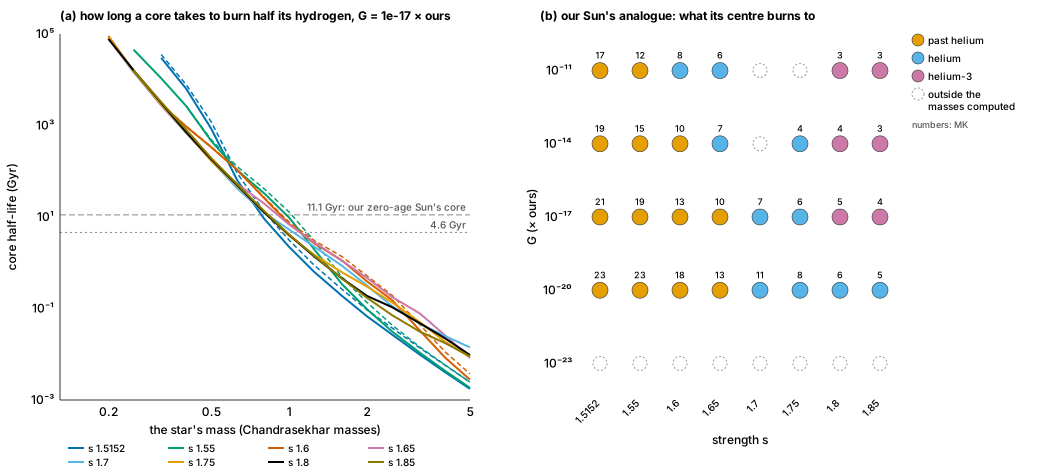
Long-lived stars are generic. 55 main sequences were run (40 in the adopted mass model and 15 in Brink’s grid where the two once differed, ). 53 of them gave 553 stars from 0.13 to 5 Chandrasekhar masses, each with the time its core, held at its central temperature and density, takes to burn half its hydrogen (figure 2a). Lighter stars burn slower, as ours do, by 6–11 decades across the range at each gravity. The slowest take up to 1 × 10⁵ Gyr. At = 10−11 × ours the heaviest burn half their core in 268 years. At = 10−23 every star computed takes at least 13 Gyr.
A Sun analogue at almost every point. Our Sun’s own centre, built by the same solver at zero age (13.5 MK, 74 g/cm³) and burnt by our measured rates at fixed temperature and density, takes 11.1 Gyr to burn half its hydrogen. The real centre took about 4.6, because a core heats and compresses as it burns (section 3.2.3). So a four-dimensional star whose zero-age core takes 11.1 Gyr is our Sun’s analogue, if four-dimensional cores evolve as ours do. 29 sequences have one inside the masses computed. Its mass, in Chandrasekhar masses at that gravity, grows as gravity weakens:
| (× ours) | the analogue’s mass () | its centre (MK) |
|---|---|---|
| 10−11 | 0.20–0.44 | 3–17 |
| 10−14 | 0.39–0.50 | 3–19 |
| 10−17 | 0.78–0.97 | 4–21 |
| 10−20 | 1.75–2.53 | 5–23 |
| 10−23 | above 5 | — |
Where none is found at stronger gravity ( at 10−11 and at 10−11 and at 10−14), the solver’s sequence starts at 0.4 or more and every star in it burns its core within 2.50 Gyr: the analogue lies below the masses computed, not outside the window. At = 10−23 it lies above them. The solver found no first star for G = 10−23, s = 1.65; G = 10−23, s = 1.7.
What the analogue burns to (figure 2b; each centre run through the network to the end of its hydrogen at its own temperature and density):
- 13 climb past helium, to elements 6–12, at 10–23 MK: every analogue at but one, and up to 1.65 where gravity is weak. At our world’s strength, = 1.5152, the centre runs at 17.0, 18.9, 20.8, 23.3 MK at = 10−11, 10−14, 10−17, 10−20; at 10−17 it ends as oeon-24 48%, gluorine-23 32%.
- 10 make helium, at 4–11 MK.
- 6 strand as helium-3, at 2.5–4.7 MK: the strongest nuclear forces, where the analogue’s centre is too cool for helium-3 to burn itself. That gives way to helium as gravity weakens: at the analogue makes helium from = 10−20.
The two mass models give the same outcome at all 12 points where both found an analogue, and its mass differs by at most 8%, as section 2’s bound on the ceryllium cycle predicts.
Real cores are less dense than the convention’s. The network’s reference density is 3 × 10¹⁷–6 × 10¹⁸ kg/m⁴ over 10–50 MK. The analogues’ centres lie at 8 × 10¹²–9 × 10¹⁷, near it at the strongest gravity and thinning as gravity weakens. A thinner core must be hotter to burn at the same pace, so weak gravity pushes figure 1’s pattern towards burning further: helium-3 stranding retreats and the climb past helium reaches higher strengths.
Burning steep enough for convective cores, without a CNO cycle. In our Sun, the pp chains’ rate rises with temperature about as and the CNO cycle’s as (computed from our measured rates the same way as below; the textbook values are and (Pols n.d.)). The steep CNO cycle is what gives our stars above about 1.25 solar masses a convective core: 0.19 of the mass at 2.5 solar masses, 0.27 at 5. Four dimensions has no cycle, but where the network climbs past helium its captures are as steep. A fresh core’s rate rises as where the pp chains carry it, and as above 18 MK at = 1.5152, where the climb does; at , which never climbs, it stays at . At = 10−17 the heaviest star computed (5 ) has a convective core of 0.19 of its mass at = 1.5152, 0.19 at 1.55 and 0.09 at 1.85. Four dimensions’ adiabatic gradient is 1/3 against our 2/5, so convection starts more easily. Light stars show small, noisy convective centres (0.01–0.06 of the mass from 0.5 up at 10−17), where ours have none. These are zero-age cores, and is a mean over the first half of the hydrogen, so a core’s sensitivity before its catalysts build up is not resolved.
3.2 Methods
3.2.1 The network as an energy law
The network of section 2 knows each rate relative to proton + proton’s at a reference density; a star needs energy per kilogram per second at its own density. The two meet through proton + proton itself. Its absolute four-dimensional rate is : our ’s nuclear factor (carried), the barrier integral through the same 4 fm barrier the network uses, times the computed nuclear overlap and four dimensions’ weak factor as the network carries them. The network’s own rate is at its reference density, so , and running the network at is burning at density . Every four-dimensional two-body rate shares the form, so one serves them all. On a grid of 31 temperatures (1–100 MK) by 11 densities (– kg/m⁴), a fresh primordial core (hydrogen 0.75, helium-4 0.25 by mass) burns at fixed and until half its hydrogen is gone. That gives the half-life and the mean energy rate over it, : the loss of atomic rest mass over , with the catalysts built up as they are in a real core. The neutrinos’ share is not taken off; in our pp chains it is about 2%. The weak coupling is the electron-matched throughout.
3.2.2 The star
Each star is a zero-age main-sequence model in four dimensions, solved by shooting from the centre and the surface to meet at a fitting mass, with Newton’s method on the central pressure and temperature, the radius and the luminosity. Its parts:
- the gas: ideal ions; Fermi–Dirac, relativistic electrons; light pressing with ;
- transport: radiation, or convection at the adiabatic gradient wherever radiation cannot carry the flux;
- opacity: scattering by free electrons through the lens vacuum (), plus classical free–free absorption from the pinned charge law, at its central value (factor 1 of a 0.5–2 band);
- gravity: pinned , which has no shell theorem, so the pull at each radius is summed over the whole profile and iterated until it settles;
- the photosphere: at optical depth 2/3.
The burning is from 3.2.1, interpolated in the logarithms. The convective core is the mass inside the innermost point where the temperature gradient falls below the adiabatic one. Each sequence starts from one Chandrasekhar mass at that (the four-dimensional limit for a white dwarf of two nucleons per electron) and walks in mass from there. Where the walk cannot start from the diffusion estimate it falls back to a grid of central temperatures.
3.2.3 The Sun analogue
A star’s core half-life at fixed central conditions is not its lifetime. The core heats and compresses as hydrogen turns to heavier nuclei, and burns faster. The solver builds zero-age stars only, so the comparison is made at zero age on both sides. Our own zero-age Sun from the same solver (13.5 MK, 74 g/cm³), burnt by REACLIB (Cyburt et al. 2010) at fixed and , halves its hydrogen in 11.1 Gyr. The real centre has done it in about 4.6. The analogue is the four-dimensional star whose zero-age core takes the same 11.1 Gyr, found by interpolating in between the two stars around it. This assumes that four-dimensional cores evolve by the same factor as ours; it is declared, not computed. The 4.6-Gyr star is kept beside it in the data.
3.2.4 What a centre burns to
The analogue’s centre, at its own and , is run through the network until its hydrogen is gone. It is classed by its main product: helium-3 or helium-4 if either is more than half the mass, past helium if nuclei of mass 8 and up are. This is section 2’s run, with the star’s own conditions in place of the convention’s.
3.2.5 Temperature sensitivity
The exponent of a fresh core’s half-life at fixed density. For four dimensions it comes from the 3.2.1 table at kg/m⁴, differenced across two grid steps. For ours it comes from REACLIB at our zero-age centre’s density, over a 10% step: hydrogen and helium alone for the pp chains at 15 MK, and our Sun’s carbon, nitrogen and oxygen at 20–30 MK for the CNO cycle. Where the energy per reaction stays fixed, is the exponent of .
3.2.6 What is computed, carried and chosen
| status | from | |
|---|---|---|
| the burning, its energy and its temperature sensitivity | computed | section 2’s network; ’s absolute rate |
| ’s nuclear factor | carried | ours, through 4D’s barrier |
| the star’s structure, gas, transport | computed | the solver, pinned gravity |
| opacity | computed, one value of a band | lens-vacuum scattering, classical free–free |
| composition | chosen | hydrogen 0.75, helium-4 0.25; no metals |
| the Sun analogue | calibrated on ours | zero-age = ours’; cores evolving as ours assumed |
| , | chosen | the axes; electron-matched |
| what happens after zero age | not computed | — |
3.2.7 Checks on our own world
| computed | textbook value | |
|---|---|---|
| pp chains’ near our Sun’s centre | 4.6 | 4 (Pols n.d., eq. 6.51) |
| CNO cycle’s at 20–30 MK | 15–16 | 18 for simple estimates; from 23 at 10 MK to 13 at 50 MK (Pols n.d., sec. 6.4.1) |
| the lightest star with a convective core | 1.25 | 1.2 on the zero-age main sequence (Pols n.d., sec. 9.2.2) |
3.2.8 Reproducing it
node four/fusion/tools/eps4.mjs (with
ALT=<a copy of four/ baked under MASS=grid>) writes
the energy law fusion/eps4.json, about 15 minutes per mass
model.
node four/atom/tools/mainseq.mjs net <G> <s> [ladder|grid] 1
builds one sequence, 5–25 minutes each. The 55 sequences ran as the
runner’s lifetimes-1; the 15 at
in the adopted model were rerun after section 2’s bound changed the
network.
node four/fusion/tools/lifetimes4.mjs <their directory>
(with ALT= and
OURS=<mainseq.mjs ours's output>) writes
data/lifetimes.json,
node four/papers/p2/figures/lifetimes.mjs draws figure 2,
and node four/papers/p2/build.mjs fills this text.
References
papers/p2/text/lifetimes.md: every number in it is read by build.mjs from the computed data or the solvers, so this text says what the code does.