The windows: which strong and weak forces let a four-dimensional universe burn hydrogen
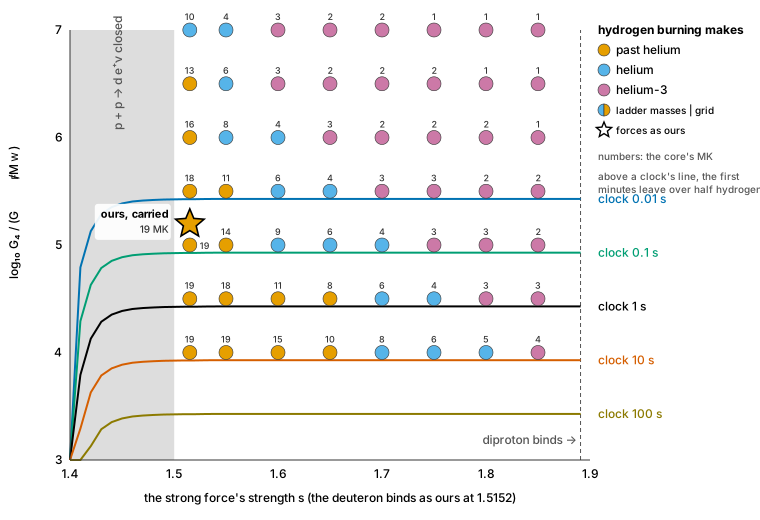
A universe with four dimensions of space has to choose its nuclear forces; nothing carries ours over. The book fixes the charge law (paper 1) and keeps two numbers open for the nucleus: the strength of the attraction between nucleons, a factor on a borrowed force of fixed shape, and the weak coupling , Fermi’s constant’s four-dimensional counterpart, which has units of mass and so no value inherited from ours. Figure 1 lays out the plane of those two choices and draws on it every constraint the book has computed, each from its own calculation. Each one rules out a part of the plane, and what is left is narrower than any one constraint suggests.
2.1 Results
The strong force’s window. The deuteron binds once , and the spin-singlet pair of nucleons binds once . Above that, two protons (or two neutrons) hold together by the strong force alone, and the slow weak step that paces hydrogen burning in our Sun disappears. Between them the deuteron’s binding rises from zero to 16.5 MeV. At it binds by 2.224 MeV, as ours does. These two edges bound the plane’s horizontal axis.
Proton + proton. In our Sun, hydrogen burning starts with , which needs the deuteron to bind by more than the neutron–proton mass difference plus an electron mass, 1.804 MeV. That happens only above , so the lowest 20% of the strong window (shaded) has no positron-emitting route to deuterium. The electron-capturing route needs only 0.782 MeV and opens at ; in our Sun it runs at a few parts in a thousand of (Vinyoles et al. 2017), so across the 10% of the window between the two thresholds deuterium is made, but slowly. The figure shades the whole strip, where itself is closed. Of the plane drawn, 78% has open and no bound diproton.
The first minutes. The universe’s first minutes turn every neutron that survives them into helium-4. A weak force too feeble freezes the neutrons out of balance with the protons while there are still many of them, and the universe starts as mostly helium. For each clock of the first minutes (the universe’s age when it is 1 MeV hot, which gravity sets and the book has not yet fixed) the coloured line marks where exactly half the hydrogen survives; above it more does. The lines are flat in , and they step down by exactly half a decade in for every decade of the clock: at clocks of 0.01, 0.1, 1, 10, 100 s (a slope of 0.500 per decade; each line flat in to 0.004 wherever is open). Both facts are the physics of freeze-out (section 2.2.4). The rate that converts neutrons and protons grows as and the expansion rate as , so the freeze-out temperature depends only on . At the edge the frozen neutron fraction is a quarter, MeV (computed: 1.18 MeV). The free neutron then lives 6 days, far longer than the wait for deuterium, so the deuteron’s binding hardly enters. The lines bend down only near the deuteron’s threshold, where the wait for deuterium becomes long enough for neutrons to decay. Depending on the clock, the first minutes leave half their hydrogen on 32–69% of the plane.
The weak window’s lower edge says something about in units of the electron: half the hydrogen survives only if is within a few orders of ours’ . The figure’s reference , the weak force “as strong as ours at its own scale”, lies 3.4–5.4 decades below the edge and leaves a universe of helium. Matching ours at the electron’s energies, (5.20 on the figure’s scale), gives a neutron that lives 4.2 hours and a freeze-out at 0.52 MeV. It keeps more than half the hydrogen for any clock longer than 0.029 s.
What hydrogen burning makes. At 56 points, the 8 strengths where the book’s reaction network has been built ( = 1.5152, 1.55, 1.6, 1.65, 1.7, 1.75, 1.8, 1.85) across = 4, 4.5, 5, 5.5, 6, 6.5, 7, the network burns a core of hydrogen and primordial helium at the temperature where half its hydrogen goes in 4.6 billion years. That is the pace of our Sun’s centre, the book’s convention until stellar lifetimes are computed. Each point is coloured by what that core ends as; the number above it is the core’s temperature in millions of kelvin. The two mass models the book carries agree at every point (0 differ; section 2.2.5):
- 27 points end as helium-3 (1.0–3.6 MK). A fast makes the core cool, and then He + He, which has a high barrier and no weak step to wait on, is too slow to finish the chain in 4.6 billion years.
- 15 points end as helium-4 (4.1–10.4 MK).
- 14 points climb past helium, to elements 6–13, at 7.8–18.8 MK: the hottest cores, at the low- end and at with a weak force 6–16× weaker than the electron-matched one.
’s weak factor against ours runs from 0.023 at to 9.1 at 1.85 at the electron-matched : four-dimensional phase space grows faster with the positron’s energy, which grows with the deuteron’s binding. So the strong and weak forces trade through . A weaker or a weaker means a slower , a hotter core at the same pace, and helium in place of helium-3.
No CNO-like cycle. The network’s one decisive uncertain mass was 5-11, a triton-like cluster on ceryllium-8. If 5-11 plus a proton could throw out a helium-4 and give ceryllium-8 back, the primordial helium would make its own catalyst (two helium-4s are bound as ceryllium-8, and protons climb from there to 5-11) and get it back: a cycle like our CNO cycle, needing no earlier stars’ carbon. Treated with every cluster free, in one calculation for all three nuclei, that step costs at least 19 MeV at , rising to 69 at 1.85 (section 2.2.5). There is no cycle, and the low- cores climb past helium.
Our world’s point. The star marks both forces as ours, carried over: the deuteron bound by 2.224 MeV, as ours is ( = 1.5152), and the weak force matched to ours at the electron’s energies, (5.20 on the figure’s scale). Its first minutes leave helium = 0.59, 0.38, 0.14, 0.01, 0.00 at clocks of 0.01, 0.1, 1, 10, 100 s (ours: 0.245). A core burning at the Sun’s pace there ends past helium (gluorine-22 81%, gluorine-23 17%) at 18.5 MK, in either mass model. So our own forces, carried into four dimensions, sit inside every window drawn for any clock longer than 0.029 s, and their stars climb past helium.
What is left. A strong force between the diproton’s edge and ’s threshold; a weak force above the first minutes’ line for the universe’s clock; and within that, hydrogen burning that ends as helium rather than stranded as helium-3, which at the Sun’s pace needs below about 1.7 at the electron-matched , and lower for a stronger weak force. The window is real and not small, but each force is held to within about an order of magnitude of a value set by another: the strong force by the deuteron, the weak force by the electron, and both together by .
2.2 Methods
2.2.1 The plane
multiplies the attractive terms of the Minnesota nucleon force (Thompson, Lemere, and Tang 1977), whose
two Gaussians and repulsive core are kept as functions of distance in
both worlds. The force’s shape is a borrowing, and its strength is the
choice. The plane is drawn on 50 strengths from 1.40 to 1.891 and 17
couplings from
to
times
in steps of 0.25 decades, at clocks of 0.01, 0.1, 1, 10, 100 s.
(1.45 × 10⁻¹⁶
MeV)
is a reference, not a claim. It is what a 4 + 1 gauge theory gives if
its coupling is ours at its own scale
(),
and quoting every
against it keeps the axis dimensionless. Produced by
fusion/tools/windows4.mjs, drawn by
papers/p2/figures/windows.mjs.
2.2.2 The strong window’s edges
Two nucleons in an s-wave with the triplet (deuteron) or singlet
(diproton) Minnesota force, solved as a radial problem in four
dimensions. The s-wave carries the centrifugal-like term
,
a barrier in 4D that our deuteron does not have. Bound states are found
by Sturm bisection on a finite-difference grid
(atom/js/nuclear.js, levels; the deuteron with
its wavefunction by deuteron), and each edge by bisection
in
(window). The singlet edge is computed without the Coulomb
force, so it is strictly the dineutron’s. The diproton binds a little
above it, and the dashed line is the conservative edge.
2.2.3 Proton + proton
The positron route needs
and the electron-capture (pep) route
,
each with the deuteron’s binding from 2.2.2. Where it is open, the
rate is computed, not assumed. The nuclear part is
,
the overlap of the deuteron with the two protons’ Coulomb scattering
state, both from the same force. The lepton part is the positron’s phase
space at that world’s endpoint, and the constant is set on our
keV b (Adelberger et al.
2011) (nuclear.js ppOverlap; on
ours it gives
against the evaluated 7.035 of the same review).
2.2.4 The first minutes
Weak rates are Fermi’s contact theory (Fermi 1934) in
dimensions (atom/js/weak.js). The coupling
has units of
mass,
and a decay’s rate is
with
the electron’s energy and
its momentum in units of
,
the unit sphere’s area, and no Fermi function (it costs 7% on our
neutron). The free neutron’s
is kept as ours: in 4D the nucleon is still the smallest spinor, and
belongs to the strong force. The hot universe converts neutrons to
protons through
and
,
with thermal, Pauli-blocked leptons and the electron’s mass kept. The
reverse rate follows by detailed balance. The neutron fraction
is integrated as the universe cools from equilibrium to a thousandth of
the expansion rate (neutronFraction), and it fixes an
equivalent freeze-out temperature
.
The clock is
,
the radiation-dominated law in
dimensions with
the free parameter that gravity will set, and one clock serves
freeze-out and the bottleneck alike (declared; ours’ two clocks, before
and after electron–positron annihilation, differ by 1.8×). The deuterium
bottleneck breaks where Saha’s equilibrium puts as many deuterons as
neutrons, with baryons per photon η = 6.1 × 10⁻¹⁰ (ours,
declared), and the helium made is
(atom/js/bbn.js firstMinutes). The edge drawn
is
,
found on the grid and interpolated linearly in
.
The scaling of section 2.1 follows from the rate’s dimensions. With massless leptons the conversion rate is and the expansion rate , so at , a function of alone. Contours of constant helium are lines of slope in against . The computed slope, with the electron’s mass and the integration kept, is 0.500.
2.2.5 Hydrogen burning at the network’s points
Nuclei. The light 4D nuclei, by protons and neutrons, are helium-4s plus at most one small cluster (a nucleon, two nucleons, a triton-like or helium-3-like cluster). Their bindings come from three calculations:
- helium-4 and mass 3 by diffusion Monte Carlo, exact for ;
- the helium-4 “ladder” ( helium-4s by Monte Carlo on their pair potential);
- the clusters on fixed draws of a core of helium-4s in Brink’s antisymmetrized-Gaussian model (Brink 1966; Freer et al. 2018) (Hill–Wheeler (Hill and Wheeler 1953) over the cluster’s placements).
The ladder and Brink’s grid are two methods, and on our own nuclei they err in opposite directions. Against AME2020 (Wang et al. 2021), for helium-4s relative to free ones:
| ¹²C | ¹⁶O | ²⁰Ne | ²⁴Mg | |
|---|---|---|---|---|
| measured | −7.3 | −14.4 | −19.2 | −28.5 |
| ladder | −1.4 | −4.9 | −10.0 | −16.0 |
| Brink grid | −5.3 | −19.9 | −35.4 | −93.3 |
(MeV.) The ladder underbinds, and the grid overbinds more as the core grows. Mixing grid clusters onto ladder cores, which the network first did, puts nuclei from the two methods side by side and decides reactions by their difference.
The adopted model keeps the ladder’s nuclei and scales every grid
separation on core
by
.
That is the ratio of the two methods’ energies to remove one more
helium-4 from the same core, so each cluster’s binding is measured
against the grid’s own helium-4 binding and carried to the ladder. On
ours it gives the 22 measured separations of a nucleon, two nucleons, a
triton or a helium-3 from cores of ⁸Be to ²⁰Ne to a median 30%, against
91% for the grid alone. The grid alone is kept as the other mass model
(fusion/tools/nuc4.mjs, MASS=ladder|grid;
fusion/tools/masscheck.mjs).
The one nucleus where they differed in kind was 5-11 on its
ceryllium-8 core: the adopted model’s scaling opened its (p,α) step at
,
Brink’s grid closed it, and ours (¹¹B + p → 3α,
MeV measured; 7.2 in the grid, 15.5 in the adopted model) could not say
which to trust. It is decided by a third calculation that treats all
three nuclei alike (brink.js freeClusterGCM,
nuclei.mjs qbound): helium-4 as one determinant, exact in
the model; the two-helium-4 core by angle-projected Hill–Wheeler,
converged (two grids agree to 0.03 MeV; ours’ ⁸Be comes out 0.085 MeV
unbound, measured 0.092, which is how the force’s exchange mixture was
set); and 5-11 by Hill–Wheeler over
placements of all three clusters, every centre free, screened by each
placement’s own energy. 5-11’s energy is variational in
,
so
is an upper bound on the model’s own
,
falling as
grows. The bound is negative at every strength already at
;
at
it is −15.7, −20.6, −27.9, −35.5, −43.5, −51.8, −60.5, −69.5 MeV at
= 1.5152 … 1.85, and doubling to
moves
from −15.7 to −18.7. Ours’ bound, 12.25 MeV at
,
sits above the measured 8.59 as a bound must. The adopted model takes
5-11 from the bound (fusion/qbound4.json), the least-closed
value it allows.
Rates. Two-body rate constants at the density of our
Sun’s centre, on a temperature grid
(fusion/tools/rates4.mjs →
fusion/data4.js):
- computed where the book has computed the reaction: (2.2.3, with 4D’s weak factor), helium-4 + helium-4 by E2 capture, and protons and helium-4s onto two to four helium-4s by E1 and E2 capture on folded potentials;
- carried otherwise: our analogue’s nuclear factor (its REACLIB (Cyburt et al. 2010) rate, from pynucastro’s snapshot (Smith et al. 2023), against our ’s, through our Coulomb barrier) put through 4D’s barrier;
- β decays from their own endpoints with ¹³N’s matrix element and 4D’s phase space;
- (p,α) branches wherever the compound nucleus sits above its helium-4 threshold, with our ¹⁵N(p,α)’s factor.
Every weak reaction is baked at the electron-matched . A point at another multiplies all of them by , exactly how the weak factor scales.
The core. Hydrogen 0.75 and helium-4 0.25 by mass,
burned at constant temperature and density by backward Euler with
Newton’s method on the analytic Jacobian
(fusion/js/net4.js). The temperature is the one at which
half the hydrogen goes in 4.6 billion years, found by bisection. It ends
as helium-3 if that holds more than half the mass, as helium if helium-4
does, and past helium if nuclei of mass 8 and above do (no point fell
short of all three).
Not in it. Electron screening; neutron captures; reverse rates’ partition functions; the star around the core (no structure, no mixing, no lifetime: the pace is the convention). Pinned gravity’s clock is a parameter, not a result.
2.2.6 What is computed, carried and chosen
| status | from | |
|---|---|---|
| the strong window’s edges, ’s threshold | computed | Minnesota at strength (shape borrowed) |
| freeze-out, neutron lifetime, first-minutes helium | computed | Fermi theory in 4D; and the clock declared |
| light nuclei | computed, two methods | Monte Carlo ladder and Brink’s grid; adopted model and band; 5-11 from the free-cluster bound |
| , ⁴He + ⁴He, captures onto 2–4 ⁴He | computed | the same force |
| other rates | carried | REACLIB analogues through 4D’s barrier |
| the core’s temperature | convention | our Sun’s pace, until lifetimes |
| , , the clock | chosen | the axes; gravity will fix the clock |
2.2.7 Checks on our own world
| computed | measured | |
|---|---|---|
| neutron lifetime (no Fermi function) | 945 s | 878.4 ± 0.5 s (Particle Data Group 2024) |
| freeze-out (clock 0.74 s) | 0.800 MeV | about 0.8 MeV (the standard estimate, not a measurement) |
| primordial helium | 0.241 | 0.2449 ± 0.0040 (Aver, Olive, and Skillman 2015) |
| ¹¹B + p → 3α, (grid / adopted / free-cluster bound) | 7.2 / 15.5 / ≤ 12.25 MeV | 8.59 MeV |
| α-cluster binding, ¹²C–²⁴Mg | ladder under, grid over | (table above) |
2.2.8 Reproducing it
node four/fusion/tools/rates4.mjs <s,…> bakes the
network (about 2.5 minutes a strength; MASS=grid for the
other model, into a copy of four/),
node four/fusion/tools/windows4.mjs (with
ALT=<that copy>) computes the plane, and
node four/papers/p2/figures/windows.mjs draws it.
node four/fusion/tools/masscheck.mjs writes ours’ check,
and node four/papers/p2/build.mjs fills this text from all
of them. The light nuclei come from the runner’s masses-1
and plusmore-1 runs.
References
papers/p2/text/windows.md: every number in it is read by build.mjs from the computed data or the solvers, so this text says what the code does.