Choosing a charge law for four dimensions: what 1/r does to atoms and the periodic table
Paper 1 of four.mino.mobi’s own journal. Every number in it is regenerated from the code and its data on every change, and the making is public at four.mino.mobi/papers. The appendices are on a page of their own, the supplement, and every reference to them links there.
Abstract
Gauss’s law gives charges in four spatial dimensions a potential, under which no atom has a ground state. We ask what atoms exist if the law between charges is instead pinned at , the only power law under which orbitals of different angular momentum share a shell. In four dimensions is not harmonic, and its price is the shell theorem: an inner cloud screens the nucleus only partly, and a neutral atom is felt from outside. We solve every neutral atom through self-consistently with local exchange, cross-checked by numerical Hartree–Fock, each method tested first on our own world. The table has rows of 2, 10, 10, 28, 28, 60 elements and noble gases at 2, 12, 22, 50, 78, 138, as the generalized Madelung rule predicts, and its larger subshells make room for 52 elements with no counterpart in ours. Solving it again with the shell theorem forced back on shows what that loss decides: the rows survive it, but what fills inside them from the first d element on does not; solving it under and moves the noble gases, so the rows themselves need the exponent 1/r. Partial screening holds outer electrons a median 2.54 times harder, so the hardest-held electron belongs to a full d shell rather than a noble gas; closed-shell atoms attract with a permanent that outranges dispersion; and four-dimensional space breaks Hund’s first rule for d², d¹⁶, 4f³ and 4f²⁹.
1 · Introduction
Why does space have three dimensions? Ehrenfest (1918, 1920) turned the question into physics. He asked what in the laws of physics would change with the number of dimensions, and found, among other things, that under the inverse-power force Gauss’s law gives in dimensions, no planetary orbit is stable for . Tangherlini (1963) carried the argument into general relativity and into quantum mechanics: the hydrogen atom with Gauss’s potential has no stable states above three dimensions. The usual conclusion is that a world with more than three large dimensions has no atoms. Callender (2005) points out what that conclusion leans on, that the laws carry over to other dimensions unchanged.
They needn’t. The literature on the hydrogen atom in dimensions (Nieto 1979; Al-Jaber 1998) and on dimensional scaling (Herschbach, Avery, and Goscinski 1993; Loeser and Herschbach 1986a, 1986b; Ghosh, Kais, and Herschbach 2020) keeps the potential at in every , mostly as a convention that keeps the problem solvable. Négadi and Kibler (1996) used the -dimensional hydrogen atom to extend Madelung’s filling rule (Madelung 1936) to any dimension; applied to four, it gives rows of 2, 10, 10, 28, 28, 60. Pyykkö and Zhao (1991) solved the atoms of a two-dimensional world by Hartree–Fock, after a table from hydrogen’s filling (Asturias and Aragón 1985). Above three dimensions there are self-consistent atoms, but not a table: Hartree–Fock for two-electron atoms in any (Loeser and Herschbach 1986a), the Thomas–Fermi atom in dimensions (Kventsel and Katriel 1981), and many-electron models from the limit of large (Loeser 1987; Loeser et al. 1994). To our knowledge this paper is the first shell-resolved self-consistent survey of the neutral atoms through in four Euclidean dimensions, for a pairwise interaction and electrons with two spin states, with local exchange, no correlation and a first-order correction for open subshells’ terms, cross-checked by Hartree–Fock. For hydrogen, Burgbacher, Lämmerzahl, and Macias (1999) set Gauss’s law against in dimensions; to our knowledge nobody has asked what the choice of does to atoms with many electrons.
This paper does both. Part I treats the law as a choice: why one has to be made, why exactly, and what it costs in four dimensions (section 2). Part II solves every neutral atom to under it (sections 3 and 4) and finds that four-dimensional space breaks Hund’s first rule (section 5). Part III solves the table again with the shell theorem forced back on, to find which of its features the law decides (section 6), and gives the pull between neutral atoms that later work on molecules starts from (section 7). The appendices, in the supplement, hold the arguments and methods in full, every check of every method against our own world, and the starting data for chemistry: valence states, the atoms’ response, and a test of the valence rule. Every number in the text is recomputed from the code and its data whenever anything changes, and checked against a ledger of 42 claims. The solvers, with their known-answer tests and a script that solves the paper’s atoms again, are released under the MIT licence at tangled.org/morphyxmino.bsky.social/four-atom; the data and the paper’s making are public at four.mino.mobi/papers.
Part I · The law
2 · The law between charges
Ask what the atoms are in a world with four dimensions of space and there is no answer yet, because the question leaves out the law between charges. In ours that law isn’t a free choice. Gauss’s law, which a local, linear field theory of charge gives, spreads a point charge’s field over the sphere around it, whose area grows as , so the potential falls as . In three dimensions that is . In four it is , and with there are no atoms.
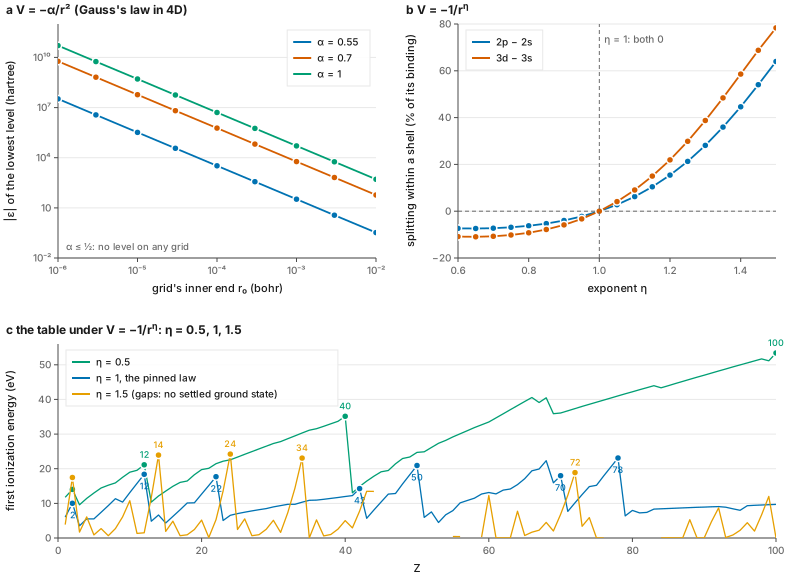
2.1 Gauss’s law leaves no atom. One electron in the pull has the Hamiltonian , and nothing in it is a length. Stretch a wavefunction, , and both terms scale by , so a bound level at would bring one at for every . Either nothing binds or the levels run down without end. Hardy’s inequality (Barbatis 2024) decides which: for the kinetic energy always outweighs the pull and nothing binds, and for the wavefunction changes sign infinitely often on the way in and the electron falls to the centre (Case 1950; Landau and Lifshitz 1977, sec. 35) (appendix F.1). Our one-electron solver shows both (figure 1a). For it finds no level on any grid. For the lowest level is −5.87 × 10³, −5.87 × 10⁵ and −5.87 × 10⁷ hartree as the grid’s inner end moves from to bohr: set by where the calculation stops, not by the electron. There is no Bohr radius, and classically no stable orbit either (Ehrenfest 1918).
2.2 The way out taken. Something has to give: the squeeze that resists the pull, or the pull. An electron whose energy grows faster than binds under Gauss’s law, at the cost of Galilean relativity for all matter. A small fourth dimension gives back three-dimensional atoms. This universe keeps the electron and four large dimensions and changes the law: the potential between charges falls as . The choice between the first route and this one is a judgement, stated as one (appendix F.2): the electron route keeps our Faraday cages, the law route keeps our mechanics.
2.3 Only 1/r keeps a shell together. Any pull with binds and has a length of its own. What singles out is a symmetry. Under every bound orbit is a closed ellipse (Santos, Soares, and Tort 2007), so the Runge–Lenz vector is conserved, and in quantum mechanics the rotations SO() together with generate SO() (Fock 1935; Alliluev 1958; Bander and Itzykson 1966). A level of hydrogen is then the set of degree- harmonics on a sphere one dimension up, so every below shares the energy, in four dimensions . Three things should be kept apart here. That each has orbitals is the four-dimensional rotations’ doing, in any central potential. That every below shares one energy is ’s, through SO(5); together they make hydrogen’s shells of 2, 10, 28 and 60 electrons, each a group of levels with a gap above it. The table’s rows are a third thing, many electrons filling subshells in an order only a calculation finds (section 4.1). Without the symmetry nothing holds the together. On the same solver 2p sits −6.2 % from 2s at , 5 × 10⁻¹⁰ % at , +15.4 % at 1.2 and +64.0 % at 1.5, as a fraction of the shell’s binding (figure 1b). Rows would still form under another exponent, but nothing guarantees they would be the same, and the generalized Madelung rule, which starts from hydrogen’s degeneracy, wouldn’t apply (appendix F.3).
2.4 What 1/r costs: the shell theorem. In four dimensions away from the charge, so there is no Gauss’s law for it: the flux through a sphere round a charge grows with the sphere (appendix F.4). A thin spherical shell of charge with radius , felt at radius , gives , , with the law’s averaged over the shell. In ours , the shell theorem, because is harmonic and a harmonic function averages over a sphere to its value at the centre; in flat space of any dimension the only potentials with one are Gauss’s, plus at most and a constant (Tse, Markowich, and Phan 2026; Landkof 1972). Here the Laplacian is negative, so : it falls from 1 to = 0.848826 at the shell (appendix A, figure A1). Three things follow. An inner cloud screens the nucleus from an outer electron only partly. A hollow conductor’s centre sits at = 1.178097 of its wall’s potential, so there is no Faraday cage. And a neutral atom is felt from outside, as at a distance , with over its electrons (section 7). Everything distinctive in Part III comes from here.
2.5 Where 1/r comes from, and what is declared. A potential in dimensions is the Fourier transform of , so the pinned law needs where Maxwell’s statics give . No local field equation gives it. Of the five routes we examined (appendix F.5), the one that survives is a vacuum whose permittivity grows with wavenumber, with a length (Tarasov and Trujillo 2013). With the permeability , the fields and obey four-dimensional Maxwell’s equations exactly, and what pushes a charge is that light seen through a lens, ; we call it the lens vacuum. Its price is relativity, for the force between charges only: the static acts across space at once. This paper uses only its statics, which are all an atom’s ground state needs. The free electron keeps its own relativity, which the lens vacuum gives up only for the force between charges, and that fixes how many electrons an orbital holds. In 4 + 1 dimensions the smallest Dirac electron has four components, the product of the four spatial Dirac matrices serves as time’s, and a slow electron keeps the two components of one chirality, which turn with one half of a four-dimensional rotation only: two spin states, two to an orbital (appendix F.6). A four-state electron is possible in principle and would double every shell. The same relativity of the free electron gives Pauli’s exclusion. The half of the spin-statistics theorem that makes half-integer spin a fermion needs only a Dirac equation and an energy bounded below, not the locality the force here lacks: electrons that could share a state would have no ground state, the pinned between them notwithstanding (appendix F.6). What stays declared is that the electron is that smallest spinor. Nuclei are point charges stable to , and the fine-structure constant is small, so atoms are solved without relativity. Single atoms don’t collapse (their energies follow the Thomas–Fermi (Kventsel and Katriel 1981), fitted exponent 2.527), but the stability of matter in bulk, whose proofs in ours lean on the shell theorem, is open (appendix F.7).
Part II · The table
3 · Methods
Everything here is computed by code written for this paper, JavaScript with no outside libraries; nothing is taken from a quantum-chemistry package, and two independent codes check it, Hartree–Fock in a Gaussian basis for any (McMurchie and Davidson 1978) and, in ours, PySCF (Sun et al. 2020) (appendix E.2). An atom is a point nucleus of charge and electrons, non-relativistic, with every pair of charges interacting through . Each electron moves in the direction-averaged field of the nucleus and the other electrons’ clouds, so the problem is radial. With , a harmonic of degree on the -sphere,
so four dimensions differ from ours by the half-integer shift of and by the degeneracies, electrons to a subshell. Four-dimensional hydrogen’s ground state is hartree; the solver gives −0.22222. Every electron–electron term goes through the kernel of section 2.4, which is where the missing shell theorem enters the atom. Exchange is local, from the uniform electron gas of the same dimension and law, with (Loos and Gill 2016) (appendix B), each electron’s own share removed (Perdew and Zunger 1981); there is no correlation term.
The radial equation is solved by Numerov’s method on a logarithmic grid, each level by Sturm bisection, and the field iterated to self-consistency. The ground configuration is searched, not assumed: from the hydrogenic filling, refilled by the orbital energies, then every move of one or two electrons among the open subshells, a candidate counting only if its field settles. First ionization energies are differences of two self-consistent energies, the ion searched for its own ground state. Hund’s first rule, which the search assumes, is checked on every open subshell by diagonalizing its terms, and the table is corrected where it fails (section 5). Two further calculations test how much of the table depends on the method and on the law. The counterfactual solves every element again with the shell theorem forced on, , everything else unchanged (section 6). Numerical Hartree–Fock, with exact exchange, ranks the same candidates a second way; its agreement with local exchange, the candidates it covers and its margins are reported separately (section 4.3, appendix E.6). The grid, the stop and the quadratures are converged well past what the text quotes (appendix C), every method has a known-answer test run on every change, and appendix G gives the methods in full.
4 · The table
4.1 Rows and noble gases. The table’s rows hold 2, 10, 10, 28, 28, 60 elements (and 2 of the next by element 140), and its noble gases are elements 2, 12, 22, 50, 78, 138, each a peak of the first ionization energy (figures 2 and 3). Those are the rows the generalized Madelung rule of Négadi and Kibler (1996) gives when applied to four dimensions (they tabulate two and three); to our knowledge this is the first self-consistent table that confirms them. The rule is a filling order, and like Madelung’s in ours it doesn’t promise each atom’s ground configuration. Read that way, 103 of the 140 are exactly the rule’s. Each of the other 37 moves one or two electrons between two subshells, 34 of them from the outer s into the d or f below it, as our chromium, copper and palladium do. The solver finds more of these departures than there are: over our first 36 elements it makes 6 where the measured configurations make 2, from its lean toward d (appendix E.3). So the 4D count is likely too high, and these departures, not the rows, are where the table is least sure.
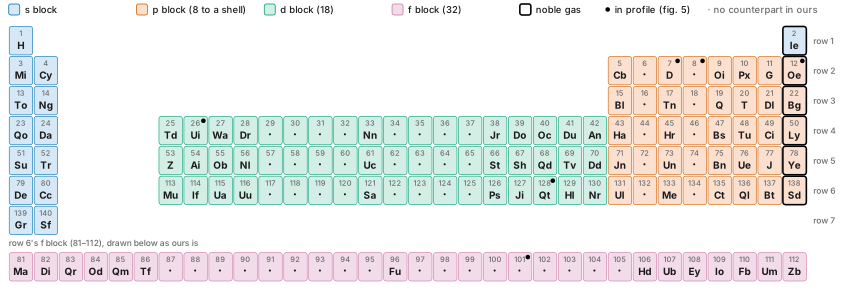
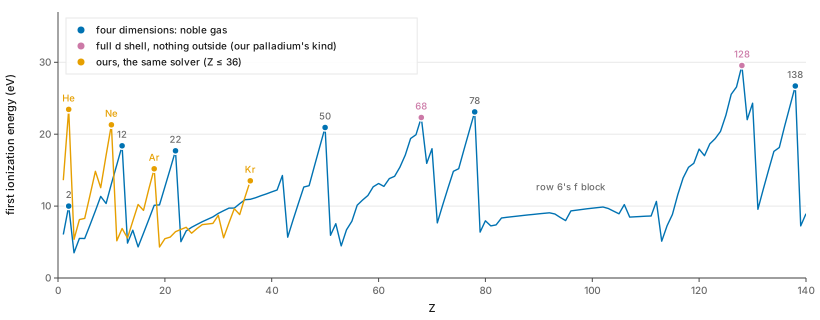
4.2 The hardest-held electron isn’t a noble gas’s. Element 128 has an 18-electron d shell, full, with nothing outside it. It holds its outermost electron at 29.56 eV, harder than its row’s noble gas 138 (26.71 eV) and harder than any other atom in the table. Element 68, the same kind a row up, comes within a volt of its noble gas 78 (22.32 eV against 23.10). Ours goes the other way: palladium’s full 4d¹⁰ gives up an electron at 8.3 eV, xenon at 12.1 (Sansonetti and Martin 2005). Searching each ion for its own ground state leaves 128’s ionization where it was. Section 6 shows the law does it.
4.3 How firm each configuration is. A second method, numerical Hartree–Fock, ranks the same candidates (appendix E.6). Agreement, the search’s coverage and the margins are reported separately. Hartree–Fock and local exchange agree on 126 of the 140 ground configurations and differ on 14: 30, 31, 37, 38, 40, 58, 61 in the d rows, where local exchange puts one electron more in d, as it does in ours; 107, 108, 109, 110, 111 at the end of row 6’s f block, where it puts one more in f; and 2 at the start of a block (53, 83). In ours Hartree–Fock gets 36 of 36 configurations right against local exchange’s 32, and where the two agree they are right. Agreement is not a guarantee, though: in our lanthanides both overbind f, Hartree–Fock by up to 4.1 eV in the measured states. Taking that as a sensitivity scale (an assumption, not a bound), 17 of the 32 elements of row 6’s f block have no competitor with fewer f within it, 5 agree with one inside it, and 4 agree with none solved. The interactive table gives each element’s group.
4.4 Every element in
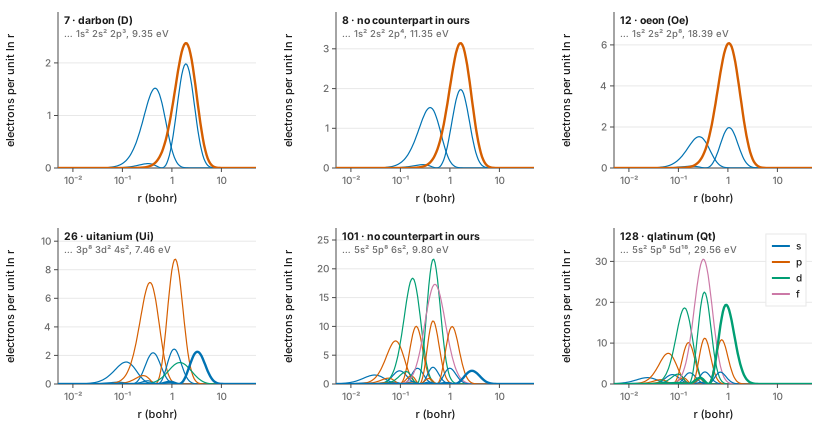
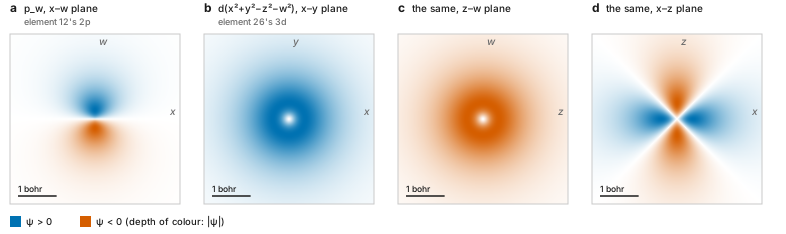
profile. Figure 4 draws six atoms’ radial
densities, and figure 5 what their outermost
orbitals look like on the 3-sphere. The same two pictures for every
element are on the interactive table, where any subshell can be cut by
any of the six planes of four-dimensional space (four.mino.mobi/table;
#Z opens on element Z). The configurations, energies,
ionizations and radii are in data/table4.csv. What
chemistry starts from, each atom’s valence states and a direct test of
the valence rule on darbon’s hydride DH₅, is in appendix I.
5 · Hund’s first rule in four dimensions
The solver gives each open subshell the most parallel spins it can hold. That is Hund’s first rule, the known answer for the ground terms of free atoms in ours. In four dimensions it is an assumption, and for some fillings it is wrong. To test it, every arrangement of each open subshell’s electrons is diagonalized under the law, on the atom’s own orbital (appendix H.1). In ours this reproduces Racah’s term separations to the wavenumber, and maximum spin is lowest in all 23 open subshells of our table.
5.1 d², d¹⁶, 4f³ and 4f²⁹ break the rule. In four dimensions all 36 open p subshells keep the rule, and so do the d fillings d¹, d³–d¹², d¹⁴, d¹⁵, d¹⁷. The exceptions are d² and its mirror d¹⁶, in all three d rows: element 26 (3d², 0.40 eV), element 39 (3d¹⁶, 0.77 eV), element 54 (4d², 0.30 eV), element 66 (4d¹⁶, 0.58 eV), element 114 (5d², 0.36 eV), element 126 (5d¹⁶, 0.63 eV). In each the ground term is a spin singlet of ten states, and the triplet the solver assumed lies 0.30–0.77 eV above it. In the f block 4f³ (element 83) fails too, and so does its mirror 4f²⁹ (element 108), each with a ground term of spin ½, 0.15 and 0.26 eV below the quartet. No other f filling was found to break the rule, though for the fullest blocks only the highest spins could be run (appendix H.2).
5.2 For d², the four-dimensional shell breaks it, not the law. On element 26’s own orbital, held fixed, Gauss’s gives the same order, the singlet 0.82 eV below the triplet against 0.40 eV under . The cause is the shell. For two electrons in a d subshell each term’s energy is exactly : the are the radial parts of the repulsion and depend on the orbital, and the over the term depend only on the term ( the angle between the two electrons seen from the nucleus). The ten-state singlet, of SO(4), holds the electrons nearest right angles, = 0.125 against random’s 0.250 and the best triplet’s 0.188, and lies below every triplet whenever 5/3. Element 26’s orbital has 0.39 under the law and 0.65 under Gauss’s, so the rule breaks either way. In ours the triplet ³F is the term that keeps the electrons nearest right angles (see Morgan and Kutzelnigg 1993, on Hund’s rules and the angles between electrons), and it is the lowest for every . Pauli keeps same-spin electrons apart, which is the usual reason for Hund’s rule; four-dimensional space gives paired spins a better way. Every four-dimensional rotation splits into a left and a right half, a d orbital carries one unit of each, and the singlet adds the two electrons’ left halves and cancels their right ones, or the other way round. Three-dimensional rotations don’t split, so ours has no such state (appendix H.3; interactive at four.mino.mobi/atom/hund.html).
5.3 The correction moves energies
and ionizations, no configuration. Where the rule fails, the
solver’s energy is the maximum-spin state’s, too high by the gap. Every
d- and f-block element was searched again with each candidate’s gaps
added (appendix H.4). The
terms change no ground configuration. They lower the eight
Hund-breaking atoms’ energies and move first ionizations in pairs, by
0.30–0.67 eV: up for an atom whose own ground term gains the gap, down
for the next, whose ion lands on the broken filling. The wider search
found one configuration the bake had missed, element 82’s 4f¹ 5d¹ 6s²,
our cerium’s kind. The table of section 4 is the
corrected one (data/table4.csv); the Hund-spin table is
supplement S1. In a ligand field the singlet survives on the 16-cell’s
eight axes and gives way to a triplet, barely, at a tesseract’s sixteen
corners (appendix H.5).
Part III · What the law does
6 · What the law decides
To see which of the table’s features the law decides, every 4D element was solved a second time with one thing changed: the clouds’ potential taken as if the shell theorem held (), and everything else, the four-dimensional kinetic energy, the degeneracies, exchange, the search, left as it was. Each search was seeded with the real table’s configuration, and the real law was re-solved in every counterfactual configuration, so a difference is the law’s, not a weaker search (appendix G.10). Of the 140 elements, 112 settle, every one up to element 88; the rest, 89–116, have no settled ground state under the shell theorem from any start tried, so what follows about the rows holds through row 5.
6.1 The rows survive the shell theorem. With the shell theorem forced on, the first 24 elements keep every configuration, and the noble gases close the same rows at elements 2, 12, 22, 50, 78, 138 (figure 6). So the rows don’t come from the shell theorem’s failure. Their lengths, 2, 10, 10, 28, 28, are sums of subshells of , filled in the order these calculations find under ; whether they survive a change of the exponent is a separate question.
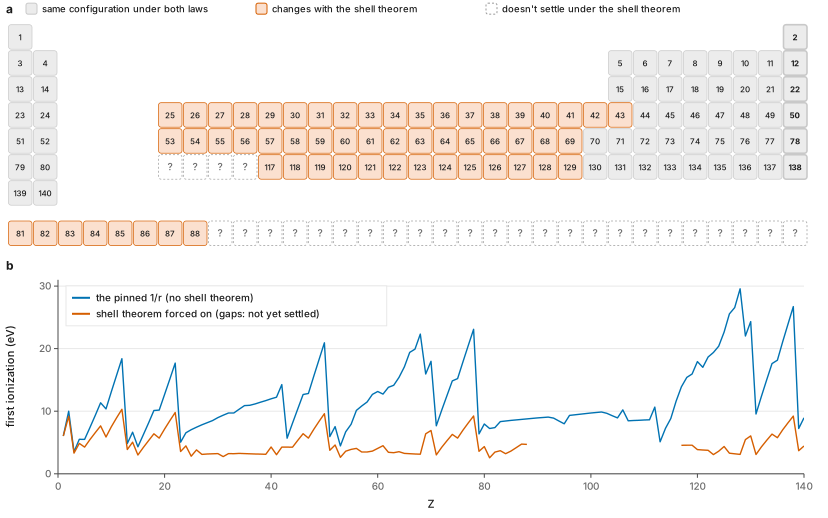
6.2 What fills inside the rows is the law’s. Of the settled atoms, 57 change configuration, the first at element 25, the first d element. Under the shell theorem p beats d: element 25 takes 4s² 4p¹ where the law gives 3d¹ 4s², and the change runs on through the d and f blocks.
6.3 Partial screening holds outer electrons harder. In ours an inner cloud screens the nucleus from an outer electron whole. Here it screens only partly, by , so outer electrons see more of the nucleus. Across the 110 atoms past helium that settle under both, the law holds the outermost electron a median 2.54 times as hard as the shell theorem would, from 1.06 to 9.55; among the noble gases the ratio grows from 1.09 (helium) to 2.90 (element 138). The largest is element 128’s: its full 5d¹⁸ shell holds its electron at 29.56 eV under the law and at 3.1 eV under the shell theorem, where the noble gases are again the hardest-held atoms, as ours are. The table’s hardest-held electron is partial screening at its strongest, a full shell whose own cloud hides the nucleus from it least.
6.4 Negative ions. Partial screening holds an extra electron harder too. One electron short of a full p shell (p⁷ in four dimensions), atoms bind an extra electron by 3.4, 5.7, 7.8, 10.3, 12.9 eV going down the group, where ours stay level (F 3.401, Cl 3.613, Br 3.364 eV, measured). 80 of the 140 bind one by more than 0.7 eV, the level above which the method held in ours (appendix E.4); the light noble gases don’t hold one at all.
6.5 The rows need the exponent 1/r. The rows survive the shell theorem, but not a change of exponent. Solved again under with and , every pair of charges alike, elements 1–100 (figure 1c, appendix F.8), the table’s noble gases move. Under an electron with more angular momentum is the more bound, element 4 is 1s² 2p², each shell fills whole before the next begins, and the noble gases fall at 2, 12, 40 and 100: hydrogen’s shells. Under the next shell’s s sinks below the current p (element 5 is 1s² 2s² 3s¹, 14 is 1s² 2s² 2p⁸ 3s²), and they fall at 2, 14, 24, 34 and 72 (82 of 100 settle). By the same rule the pinned law’s fall at 2, 12, 22, 42, 50, 70 and 78: its noble gases and two closed d-and-s atoms of zinc’s kind. Only gives the rows the generalized Madelung rule predicts.
7 · Neutral atoms aren’t silent
Under the shell theorem a neutral atom is invisible from outside its cloud. Here it isn’t. A shell of charge and radius , felt at a distance outside it, gives with (appendix A). Summed over the nucleus and the electrons the leading terms cancel, and what remains, for an electron at distance , is a pull with . The solved noble gases follow it: at 30 bohr the full cloud’s potential and the far form agree to 0.22 %. Between two atoms with round clouds (closed shells, or a single s electron) the same failure gives a permanent attraction , with no dipole needed, which outranges London’s ; an open p, d or f shell isn’t round, and adds an ordinary quadrupole pull of the same order that depends on how the atoms are turned (appendix J.2).
For two like atoms the permanent pull’s coefficient is , and is the distance inside which dispersion is the larger, with from the solver’s coupled response by Casimir and Polder’s integral (appendix J.1, table 2; in ours its noble gases’ polarizabilities are off by −8 % to +4 % against Derevianko, Porsev, and Babb (2010)). These are computed for 15 four-dimensional atoms, those whose clouds are round: for hydrogen and helium is 28 and 9.26 bohr, for the alkali-like and alkaline-earth-like atoms sampled 4.9–94, and for the other 5 closed-shell atoms sampled 0.59–1.5, inside the atom. Among them, past contact, the permanent term is the leading pull at every distance where a far-field form applies. Pulled apart by Hartree–Fock, two closed-shell atoms follow it (1.02–1.06 times the far form at 16 bohr), so the atoms the molecular codes separate into are this paper’s (appendix J.2).
That sets a requirement on every later model of four-dimensional matter. In ours the trace of a charge distribution’s second moment is dropped from multipole expansions, because is harmonic and the trace carries no field. Here it is a neutral atom’s leading field, so a four-dimensional force field has to keep it; the later papers’ do, as a cloud term on every atom.
8 · Limitations and conclusion
Limitations. The force acts instantly (section 2.5), so only statics are safe, and nothing here moves. Heavy atoms would need relativity, which the law has given up for the force between charges, so the table past about element 100 is a first pass; round a point nucleus the innermost Dirac level fails at in four dimensions (Katsura and Aoki 2006; GU, MA, and DONG 2002), beyond the table. Nuclei are declared stable to . The method has local exchange and no correlation, which in ours favours d by about a volt (appendix E.3), every subshell’s cloud averaged over the sphere, and open subshells’ terms resolved to first order on the solver’s own orbitals. The counterfactual leaves row 6’s f block unsettled. Nothing here claims that four-dimensional chemistry looks like ours; the next papers take up bonds, liquids and crystals under the same law.
Conclusion. A world with four large dimensions of space has to choose its law between charges, because Gauss’s law gives it no atoms. Pinned at , the only power law that keeps a shell together, it has atoms, and they have a periodic table: rows of 2, 10, 10, 28, 28, 60, noble gases at 2, 12, 22, 50, 78, 138, as the generalized Madelung rule predicts. The rows survive the shell theorem forced back on but not a change of exponent: they need itself. What fills inside them from the first d element on doesn’t survive the shell theorem, because in four dimensions isn’t harmonic and an inner cloud screens only partly: outer electrons are held about two and a half times harder, the hardest-held electron belongs to a full d shell rather than a noble gas, and a neutral atom pulls from afar. And four-dimensional space breaks Hund’s first rule for d², d¹⁶, 4f³ and 4f²⁹; for d², on element 26’s orbital, Gauss’s breaks it too.
Author contributions
minor mobius chose the question and the law between charges, judged the results and directed the work. Claude wrote the solvers and the tests, ran the calculations and wrote the text. Astra audited the claims, the references and the reproduction, in rounds whose findings and answers are on the paper’s process page. Claude and Astra are AI systems.
Supplementary material
The supplement holds the notation and appendices
[A](supplement.html#app-a)–K: the arguments and methods in full,
every check against our own world, the starting data for chemistry, the
atoms’ response, and how to reproduce every number. Supplement S1 is the
table with every open subshell given Hund spins (data/table4-hundspin.csv).
The 42 claims this text rests on, each recomputed from the data behind
it, are in ledger.json and on
the paper’s process page; the solvers,
MIT-licensed, are at tangled.org/morphyxmino.bsky.social/four-atom,
the interactive table at four.mino.mobi/table, and figure
5’s hydrogen twin at kata.mino.mobi/orbital.
References
papers/p1/text/: every number in it is read by build.mjs from the solver, the bake or the runs, so this text says what the code does. Rendered by pandoc with MathML.